Chapter 2
Room Tone: The Instrument You Didn't Mean to Record
What Is Room Tone (Noise Floor)?
Room tone is the sound your room makes when you are not singing — the air conditioner, the fan, the computer's hum, traffic at the window, and the way sound bounces off your walls and ceiling. You did not tune it and you did not play it, but the microphone hears it, and it is recorded onto every take. There is no take without it. And that is not automatically a problem — a recording space is not supposed to be a dead vacuum. The real question, which this chapter keeps coming back to, is whether the room complements the performance or takes away from it.
Room tone is also called the noise floor: the level, in the file, of everything that is not the voice. The standard in this manual, in one line: the floor sits low enough that in the gaps between phrases you hear quiet, not a hum. That is a fact the Certifier reads from your file, alongside the level and clipping Chapter 1 (Gain Staging) covered.
Why Room Tone Matters for Remote Vocalists
Chapter 1 (Gain Staging) said it once already: the room comes up with the voice. Raise a quiet take to a useful level and everything in it rises too. But room tone is not just a gain-staging problem — it is a problem of its own. A take can be staged perfectly and still fail, because the room itself is too loud, or too full of echoes.
The binding constraint in a home recording is the room, not the microphone. A good studio microphone's own noise is 10 dB-A or less — dB-A being the decibel scale weighted to how the ear actually hears. Even a quiet, ordinary room contributes more noise than that. The microphone is not the problem; it faithfully captures what the room is doing, at the level you give it. A professional take sounds clean partly because the room works with the voice instead of against it — and because the sounds that are never musical, the hum and the fan, were quiet enough, by measurement, that nobody hears them.
The registry measures this from the file itself. A contractor can see how a delivered file actually behaves — its level, its clipping, its room — before spending a minute of session time. The floor is one of the facts on every listing.
How Room Tone Fails in Home Recordings
1. Background Machine Noise
The most common failure is the easiest to hear: a hum, a fan, or an air conditioner sitting beside the voice on every take. These sources are steady, and steady sounds stop getting your attention. You notice them only when the voice stops — which is exactly when a producer notices them. A single fan running near the microphone can hold a room's floor in the audible band, no matter what microphone you own. Machine noise is never musical. It only takes away.
2. Untreated Room Reflections
A room contributes a second way, and it is harder to name. Sound bounces off the walls, the floor, the ceiling — bounces so fast and small you do not hear them as echoes. You hear them as a dullness wrapped around the voice, as if the song were being sung into a closet. Reflections do not raise the measured floor the way a fan does. But they are a large part of why the same voice sounds amateur in an empty bedroom and clean in a studio. And it is not because a studio room is silent — legendary rooms like Ocean Way and EastWest are booked for the sound of the room itself. It is because those rooms complement a performance, and an untreated bedroom takes away from it.
3. Printed Compression Artifacts
Compression — a device that keeps volume steady by turning loud parts down and quiet parts up — is often printed into the file: baked in at tracking instead of left live for the mix engineer to decide. The mix loses the choice. And printed compression raises the measured floor by 5–6 dB, dB for dB — it lifts the silence along with the voice. A quiet room with printed compression reads 5–6 dB worse than it is, and can land in a band it did not earn. That is why the registry reports the file floor and the room floor separately, as Chapter 1 noted.
The 4 Published Noise Floor Bands
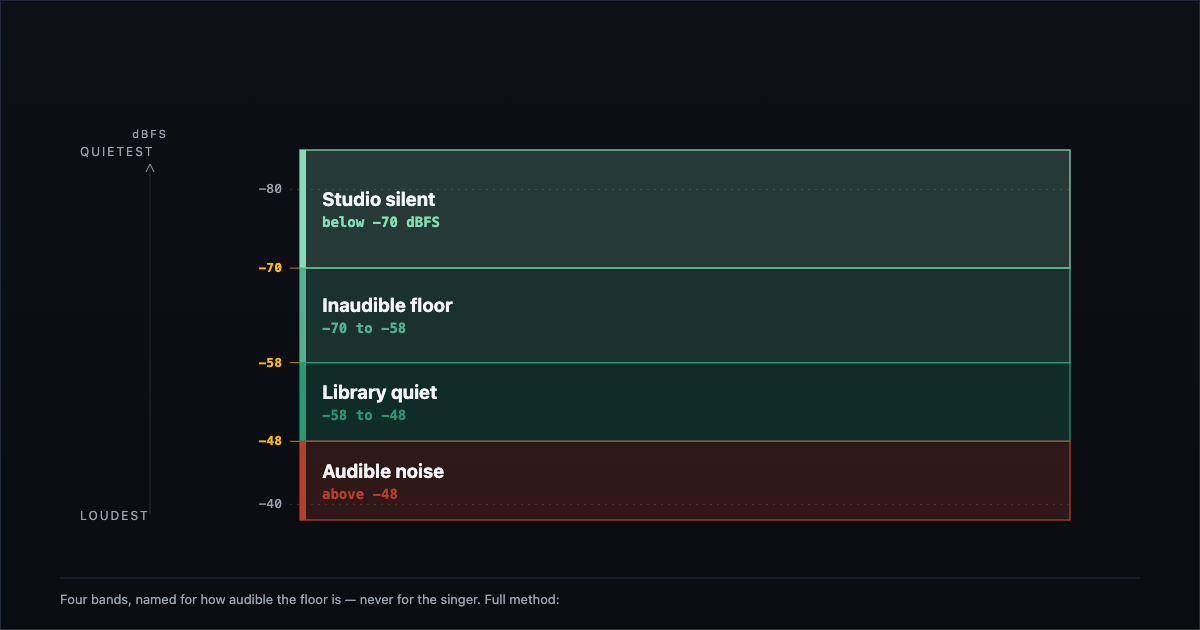
The bands below are published, not guessed. The industry had no published noise-floor standard for sung vocals, so the registry measured real distributions of delivered files and published one, with the evidence, at /noise-floor — Chapter 1 told that story. The four bands, in the order a room usually falls through them:
| Band | Range (dBFS) |
|---|---|
| Studio silent | below -70 |
| Inaudible floor | -70 to -58 |
| Library quiet | -48 to -58 |
| Audible noise | above -48 (the floor is audible beside the voice) |
- The -58 boundary is the youngest of the three and is under active calibration against delivered, client-approved session files.
- The Certifier reports the floor from the file itself. If compression was printed in, the number it reports is the file floor — the room's true floor sits 5–6 dB below it.
- Your room's position on this table is not a claim you make. It is a measurement the file carries — and it is the fact most home recordings live or die on.
A Quiet Room Is Not a Dead Room
Because "quiet" can be misread, one thing needs saying plainly: a recording space is not supposed to be a dead vacuum. Some rooms have musical room tone. The iconic recordings of the 50s, 60s, and 70s carry room tone that works with the music, and rooms like Ocean Way and EastWest built their names on character, not silence. The question is never whether the room makes any sound at all — it is whether the room complements the performance or takes away from it.
The answer also depends on the work. Film voice-over wants a near-vacuum dead room. A sung vocal for a record may want natural room character. The bands above measure the floor — hum, fans, air conditioning, the sounds that are never musical and only take away. Those are what fail a file. The Certifier measures the facts; what those facts mean depends on the job.
What a Passing Noise Floor Sounds Like
Passing: in the gaps between phrases you hear quiet — a hush that sits well back, with nothing in it you can name. The voice stays close and direct, phrase to phrase, the way it does when you are standing next to the singer.
Failing: in the gaps you can name what is there — a hum, a fan, an air conditioner, traffic at the window. Or the voice sounds wrapped and boxy, as if it were sung into a closet. Or a compressor was printed into the file, and the silence sits 5–6 dB higher than the room really is.
How to Test and Check Your Room Tone
You do not need new gear to check your room. You need thirty seconds of silence and the Certifier.
First, the silence check. After a take, play the gap right after a phrase and hold still. If you can name what you hear in the silence — a hum, a fan, an air conditioner — the floor is doing its work. If the gap just sounds like quiet, you are in the right neighborhood. But the ear is not a meter: what sounds quiet at close range is not the same thing the file reports. The number is what counts.
Second, the comparison check. If a fan or an air conditioner is running, record one phrase with it on and one with it off. The difference between those two takes is your room's loudest problem, and it is a fact you can hear in two takes.
Third, the measured check. Run the file through the Certifier. It reads the floor from the file the same way it reads level and clipping, and tells you which of the four bands your room lands in — a fact, not an opinion, dated and citable.
Quieting the room — what to switch off, what to put on the walls, where the microphone sits to keep the room out of the take — is a step-by-step workflow, and it lives in the Reel Kit. This chapter gives you the standard and the check.
Run your file through the free Certifier — ninety seconds, no signup — and see where your room lands.